Confessions at 30,000 Feet: Why We Spill Our Secrets to People We'll Never See Again
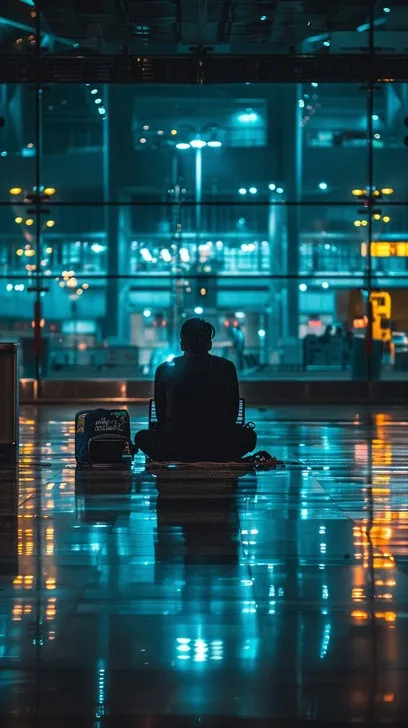
Photo: traveler sitting alone in airport terminal at night looking contemplative, via images.stockcake.com
You're sitting in a plastic chair at O'Hare, your flight delayed by two hours, when the woman next to you starts talking. Within twenty minutes, you know about her divorce, her estranged daughter, and the reason she's flying to Lisbon alone for the first time in her sixty-three years on earth. You share things back — things you haven't said out loud in years. Then your gate number changes, you both stand up, and just like that, she's gone forever.
This happens constantly. In taxi backseats in Bangkok. On overnight trains through Eastern Europe. In the smoky common rooms of youth hostels in Buenos Aires. Somehow, travel turns ordinary strangers into accidental confessors — and we into willing penitents. The question worth sitting with is: why?
The Safety of Disappearing
Psychologists have a term for it: the stranger on a train effect. The concept is simple enough — we tend to open up more honestly to people we don't expect to encounter again. No long-term social consequences. No reputation to protect. No risk of running into them at Thanksgiving dinner.
But travel amplifies this dynamic in ways that everyday life simply can't replicate. When you're physically removed from your ZIP code, your job title, your social circle — all the scaffolding that holds your identity in place back home — something loosens. You become, briefly, a person without a fixed context. And that kind of freedom? It's surprisingly easy to talk from.
Think about it: the version of you that shows up at your high school reunion is performing. The version of you sitting in a departure lounge at 11 p.m., exhausted, a little disoriented, watching the city lights blur outside the terminal windows — that version is just... present. Unguarded. Strangely open.
Distance as Permission
There's also something geographical happening here. Physical distance from home functions, on a psychological level, almost like emotional permission. The further you are from the people who know you — really know you, or think they do — the more room you have to say things that don't fit neatly into the story they've already written about you.
Your college roommate knows you as the responsible one. Your family knows you as the funny one who never takes anything too seriously. But the guy sitting across from you on a four-hour bus ride through the Portuguese countryside? He knows nothing. You can be the version of yourself who's scared, or grieving, or wildly uncertain about the next chapter of your life. You can say I don't actually know if I'm happy without watching someone's face fall in surprise.
This is especially true for Americans, who tend to carry a cultural pressure to perform optimism. We're a nation that loves a comeback story, a pivot, a silver lining. Admitting that things are hard — really, deeply hard — can feel like a social risk at home. But somewhere between customs and the baggage carousel in a foreign airport, that pressure lifts.
The Equalizer Effect of Being in Transit
Travel has this radical, democratic quality: it strips away the usual markers we use to sort each other. In a hostel dorm room, the investment banker from Manhattan and the schoolteacher from rural Ohio are both just people with jet lag and a bottom bunk. The shared experience of being somewhere unfamiliar — navigating an unfamiliar metro system, struggling with a menu in a language you don't speak, getting rained on in a city that wasn't in the forecast — creates an instant, wordless solidarity.
Across cultures, this phenomenon shows up in different shapes but with the same emotional core. In Japan, the tradition of uchi-soto — the strict distinction between one's inner circle and the outside world — softens noticeably among travelers in transit. In Latin American countries, where family bonds are famously tight and personal matters stay personal, long-distance bus rides are famous for producing confessional conversations between seatmates who've never met. The liminal space of travel seems to be a near-universal solvent for social walls.
Why Taxi Drivers Know Everything
If airports are the grand cathedrals of travel confession, taxi drivers are the quiet priests. There's something about the physical setup — two people, one facing forward, one facing back, unable to make sustained eye contact — that makes honesty feel less exposed. It's not unlike therapy, actually. The couch, the slight distance, the sense that the other person is listening without fully watching you.
Uber drivers across the U.S. have noted this for years. People say things in backseats they'd never say at a dinner party. Grief. Infidelity. Career regrets. Big dreams they've never spoken aloud. The driver becomes a witness with no stake in the outcome — and that's a genuinely rare thing in adult life.
Globally, this plays out in rickshaws in India, tuk-tuks in Thailand, dolmuş minibuses in Turkey. The moving vehicle, the stranger at the wheel, the city or countryside scrolling past the window — it's a confessional booth that every culture seems to have independently invented.
What We're Really Looking For
Here's the thing that gets lost in the novelty of it all: these moments aren't really about the strangers. They're about us — our need to be witnessed without consequence, to say a true thing out loud and have it received without judgment or history attached to it.
Mahal kita. In Filipino, it means I love you — but more literally, it's closer to you are dear to me. There's an intimacy in that phrase that doesn't require years of relationship to earn. It can arrive suddenly, in a single conversation, between two people who will never share a meal or know each other's last names.
Maybe that's what travel keeps teaching us, over and over: that connection doesn't need permanence to be real. That a true thing said to a stranger in an airport still counts as a true thing. That sometimes the people who hear us most clearly are the ones we meet in the in-between spaces — the terminals, the overnight trains, the shared taxis — precisely because they have no reason to hear us any other way.
The Story You Left Behind at Gate B12
So the next time you find yourself deep in a conversation you didn't plan to have — with the older gentleman at your gate, the woman who ends up in the adjacent seat, the hostel roommate who can't sleep either — don't dismiss it as small talk that got out of hand.
Something real is happening. You're in a temporary pocket of safety, a place where the usual social contracts are suspended and something more honest gets to breathe. You're being, for a few hours, entirely yourself — unattached from the roles you play at home, free from the expectations of people who think they already know your story.
That's not just a quirk of travel psychology. That's one of the most quietly profound gifts that moving through the world has to offer. Cherish it. Say the true thing. Let the stranger say theirs back.
Your flight is boarding soon anyway.