Somewhere You've Never Been Feels Exactly Like Home: The Hidden Geography of Who You Are
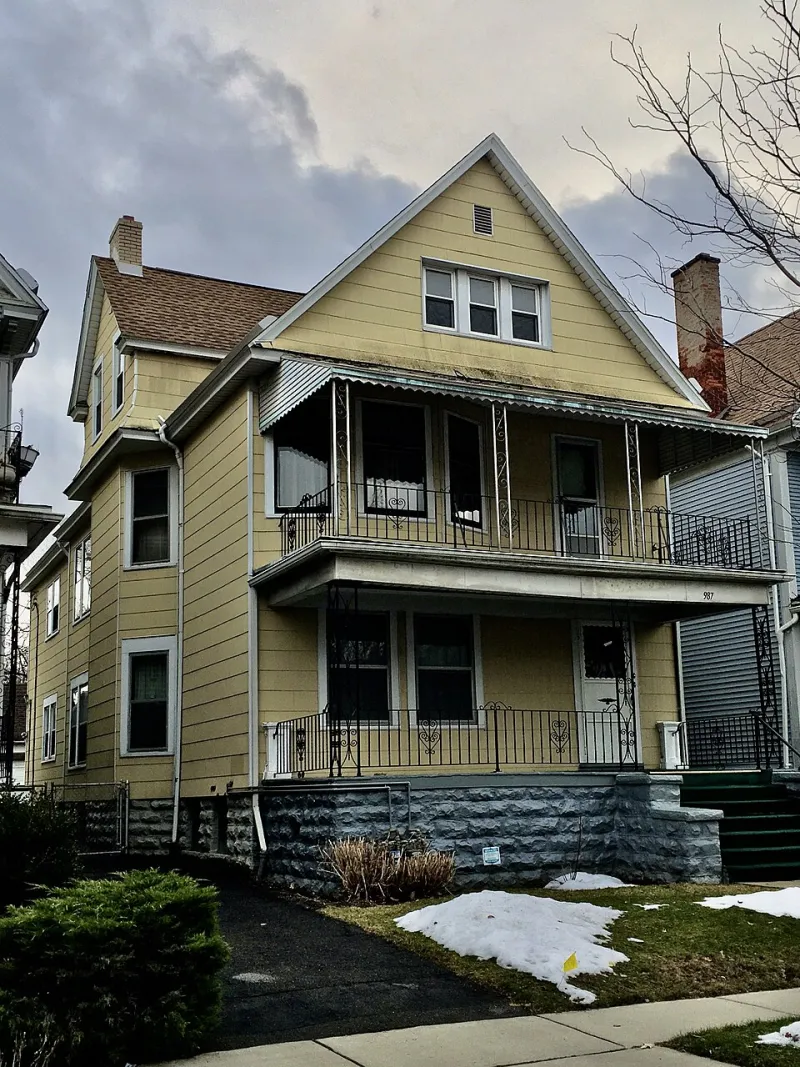
Photo: Andre Carrotflower, CC BY-SA 4.0, via Wikimedia Commons
You step off a train in a city you've never visited. Maybe it's Pittsburgh. Maybe it's Porto. Maybe it's some mid-sized Midwestern town with wide streets and a water tower you can see from four blocks away. And something in your chest does a thing it wasn't supposed to do. A loosening. A recognition. You think: I could live here.
You can't explain it. You chalk it up to good lighting or low rent or the smell of someone's backyard grill drifting through an open window. But what if it's something older than that? What if the city isn't speaking to your present self at all — but to the kid who memorized the layout of a neighborhood you haven't thought about in years?
The Blueprint You Didn't Know You Were Drawing
Developmental psychologists have a term for the mental map we build in early childhood: a cognitive map of place. Between the ages of roughly three and twelve, we're not just learning where the grocery store is or which corner has the mean dog. We're internalizing a spatial grammar — the relationship between open space and safety, density and belonging, familiar faces and the feeling of being held by a place.
That grammar doesn't dissolve when we move away. It migrates with us, running quietly in the background like an app we forgot to close. And it shapes, in ways we rarely examine, what kinds of environments make us feel okay in our own skin.
Some of this is beautifully practical. If you grew up in a walkable neighborhood in Chicago or Queens, chances are a suburb with no sidewalks will always feel slightly off — not dangerous, exactly, just wrong in a way you can't fully articulate. If your early years were spent in a small town where you knew the name of every shopkeeper, an anonymous high-rise city might produce a low hum of unease no matter how long you live there.
But some of it is stranger and more tender than that.
When the Map Belongs to Someone Else
For immigrants and the children of immigrants — a significant and growing portion of the American population — the childhood map gets complicated in ways that are equal parts loss and gift.
Take Maricel, who grew up in a suburb of Manila before her family relocated to Southern California when she was nine. She spent years feeling vaguely uncomfortable in the sprawling, car-dependent landscape of the San Fernando Valley. Then, in her late twenties, she visited a friend in New Orleans' Mid-City neighborhood. The density. The heat pressing down on everything. The sound of neighbors through thin walls. The way the streets curved in ways that didn't quite make logical sense.
"I cried in the car on the way back to the airport," she says. "Not because I was sad. Because I felt like I'd found something I didn't know I'd lost."
She'd never been to New Orleans before. But her nervous system had been to somewhere very much like it.
This is the particular bittersweet ache of the third-culture experience — growing up between worlds, absorbing the sensory fingerprint of a place that may no longer exist in the same form, or that you can only return to as a visitor. The internal map remains, but the territory it was drawn from keeps shifting.
Nostalgia Isn't About the Past. It's About the Body.
Here's the thing researchers keep bumping into: nostalgia for place isn't really a cognitive experience. It's a somatic one. It lives in the body before it reaches the brain.
The smell of certain trees. The angle of afternoon light in October. The particular echo of footsteps on a specific kind of pavement. These aren't memories we retrieve — they're sensations that retrieve us. They pull us back into the felt experience of being a child in a particular geography, complete with all the emotional weather that came with it.
Which is why a neighborhood in Denver can suddenly feel like the block you grew up on in Baltimore, even though the architecture is completely different. Something in the light, the scale, the ambient sound — some combination of variables your conscious mind never catalogued — matches the emotional frequency of a place you once called yours.
For relocators and frequent movers, this phenomenon can be genuinely disorienting. You spend years searching for a city that fits, cycling through apartments and zip codes, not quite understanding why some places feel like putting on a coat that belongs to someone else. And then one afternoon, in a neighborhood you stumbled into by accident, the coat fits. And you have to sit down.
The Neighborhoods We Grieve
Gentrification has introduced a particularly modern wrinkle into all of this. Millions of Americans — disproportionately Black, Latino, and immigrant communities — have had their childhood geographies physically erased or transformed beyond recognition. The coffee shop where the barbershop used to be. The condos where the park was. The neighborhood that your map is drawn from, now populated by people who don't know what it used to be.
This isn't just a social justice issue, though it absolutely is that. It's also a psychological one. When the territory no longer matches the map, people describe a kind of ambient grief that's hard to name. A homesickness for a place that technically still exists. A sense of being a ghost in your own history.
Community researchers who work with displaced populations note that this grief is often dismissed because the person is still in the same city, sometimes even the same neighborhood. But the felt landscape — the one the body remembers — is gone. And that loss is real.
Finding Your City Before You've Found It
There's a quieter side to all of this, though — one that's less about loss and more about discovery.
Some people spend decades in cities that never quite claimed them, then land somewhere new and feel the click of recognition they'd been waiting for. A transplant from rural Georgia who finds her people — and her nervous system — in Portland, Oregon. A former New Yorker who moves to Medellín, Colombia for six months and realizes he's been a Latin American city person his entire life without knowing it.
What these stories share is a sense that the body knew something the mind hadn't caught up to yet. That the childhood map, with all its encoded preferences and sensory loyalties, was quietly pointing toward a place the person hadn't arrived at yet.
Mahal kita — I love you in Filipino — is a phrase that implies presence, a reaching toward something. And maybe that's what this whole phenomenon is: a kind of long-distance love affair between who we became and the place that first taught us what the world felt like.
Reading Your Own Map
If you've ever felt inexplicably at home somewhere new, or inexplicably out of place somewhere you're supposed to belong, it might be worth sitting with some questions. What did your earliest neighborhood feel like, spatially? Dense or open? Loud or quiet? Full of faces you knew, or anonymous? What was the light like? What did you hear from your bedroom window?
You might be surprised how much that early geography is still giving you directions.
The maps we carry aren't obstacles or nostalgia traps. They're information. They're the original data set from which everything we know about belonging was drawn. And sometimes, when we pay attention to them — really pay attention — they lead us somewhere we didn't know we were trying to go.
Somewhere that feels, against all logic, exactly like home.