Twenty-Three Kilos of Home: What We Pack When We're Not Coming Back
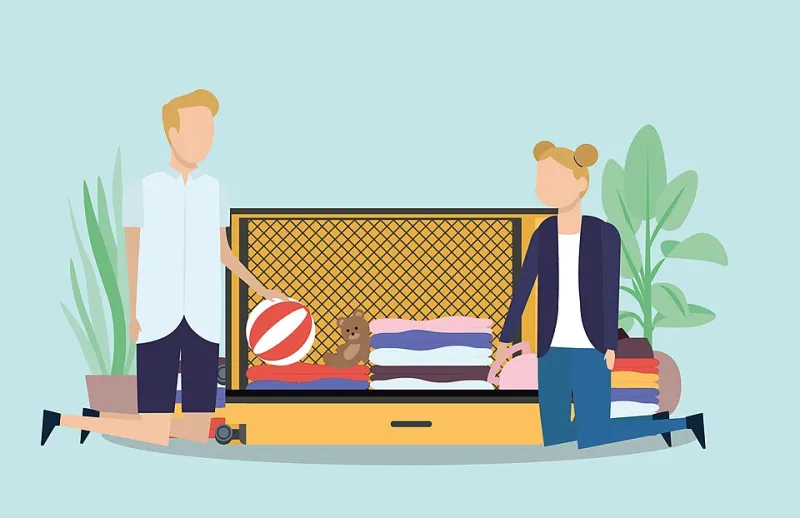
Photo: Familydestinationsguide.com Images, CC BY 2.0, via Wikimedia Commons
Start with the bag. Before the visa, before the goodbye at the gate, before the long fluorescent-lit walk to a seat you'll remember the row number of for years, there is a bag — and a decision about what on earth deserves to come with you.
You have, say, twenty-three kilos. Maybe less, if you're flying an airline that charges by the centimeter of hope. Twenty-three kilos to represent a whole life. This is not an aesthetic problem. It is a philosophical one.
The Suitcase Rule
Everyone who has migrated develops a personal rule, and almost nobody's rule is about practicality.
A woman I know in Ohio packed eleven jars of her mother's adobo spice mix, each one double-bagged in Ziploc and wrapped in socks like it was fine china. A man in Seattle brought four pounds of coffee he could have bought at any grocery store in his new zip code, because his uncle roasted it and the smell did something no imported bag ever could. A nurse in Queens devoted an entire carry-on to a folder of medical records, notarized and translated and photocopied twice — the paper proof that her children had once been small and healthy and hers.
Practical? Some of it. Devotional? All of it.
What Actually Goes In
The packing lists people describe are startlingly consistent.
Something to smell. Spices, coffee, soap, the particular incense your grandmother burned. Scent is the fastest route to a place you can't drive to, and everyone seems to know it without being told.
Something to read. A prayer book. A tattered novel. A notebook of recipes in handwriting that will not be reproduced again. Words are the cheapest way to smuggle a whole room across a border.
Something for the body. The sweater that belonged to someone. A pair of earrings you do not actually like but cannot leave behind. Clothing is memory that gets to travel on your own shoulders.
Something for the record. Photographs — physical ones, because phones die and cloud accounts are not the same as proof. The printed picture is a stubborn object, and stubbornness is exactly what you're going to need.
Something useless. This is the category that breaks people open in interviews. The wooden spoon. The chipped mug. The key to an apartment that no longer belongs to the family. Useless objects are the heart of the suitcase, because they are the ones chosen purely for love.
The Things That Stay
The other half of the story is what doesn't make it. Nobody tells you that leaving involves a series of tiny auctions you conduct with yourself at two in the morning.
The furniture goes. The books — most of them — go. The bed you slept in for nineteen years goes, and you never see the person who takes it. There is a specific, quiet grief in watching your childhood room become a storage room, then a spare room, then a room someone mentions casually on the phone as if it were always just a room.
And some things stay because they cannot be moved: the tree your father planted. The route you walked to school. The exact bend in the road where the light hit the fence at four in the afternoon. The way the neighborhood sounded on a Sunday.
You will carry those without luggage. They weigh nothing on a scale and roughly everything everywhere else.
The Weight We Choose
Here's the part I find most beautiful about the twenty-three kilos: nobody packs for survival. If they did, the bag would be full of protein bars and phone chargers.
People pack for continuity. They are not bringing things to a new country; they are bringing pieces of the old one forward, so that the person who arrives is recognizably the person who left. A spice jar is a small act of defiance against erasure. A prayer book is a claim on a ritual. A photograph is a sentence that begins remember when and refuses to end.
And in the United States, those bags leak out into the rest of us in wonderful ways. The spice aisle expands. The block gets a bakery. A neighbor's kitchen smells like somewhere you've never been at seven in the evening, and you find yourself standing in your own driveway, homesick for a place that isn't yours. That's the suitcase unpacking itself, slowly, over decades.
The Return Trip
One more thing, because it happens to almost everyone: the second suitcase.
The first one is packed by the person leaving. The second is packed by the person returning — older, with different rules, going back to visit. And it is usually lighter, because by then you've learned that home is not something you can fit into a bag. It's something you negotiate with, on the phone, over dinner, in the middle of a story you're telling someone who has never tasted that spice and probably never will.
Pack the wooden spoon. It won't make sense to anyone at customs, and it doesn't have to.
It makes sense to you.