No Translation Needed: Why a Song You've Never Heard Can Break Your Heart Open
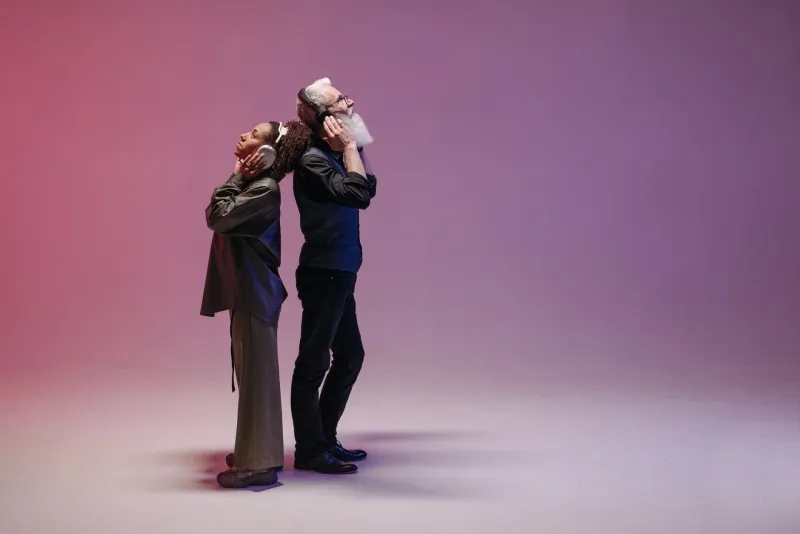
It happens in the most ordinary moments. You're scrolling through a playlist a friend shared, half-distracted, maybe folding laundry or sitting in traffic on the 405. Then something comes on — a voice singing in a language you've never studied, over an arrangement you can't quite place — and suddenly, inexplicably, your throat tightens. You feel seen by something you can't even literally understand.
If that's ever happened to you, you're far from alone. And it's not a glitch in your emotional wiring. It might actually be the most human thing about you.
The Body Knows Before the Brain Does
Music researchers have spent decades trying to decode what they call "music-evoked emotions" — the feelings that bubble up when we hear certain sounds, regardless of our cultural background. What they keep finding is striking: certain sonic qualities, like a slow tempo, a minor key, or a particular vocal tremor, communicate sadness or longing across cultural lines with surprising consistency.
Dr. Samuel Mehr, who has studied music cognition at Harvard, has noted that even people from isolated communities with no prior exposure to Western music can identify basic emotional intent in unfamiliar songs. We're wired, it seems, to read the emotional subtext of music before our conscious mind even clocks the melody.
Music therapist Anaya Reyes, who works with immigrant communities in Los Angeles, sees this play out in her sessions every week. "I have clients who come in carrying grief they can't put into words — sometimes because they're still learning English, sometimes because the grief itself is too big for words in any language," she says. "When I play something that resonates — even if it's from a completely different tradition than theirs — something unlocks. The music does the heavy lifting that conversation can't."
Streaming Changed Everything (And We're Still Catching Up)
For most of American music history, discovering world music required effort — flipping through import bins at a record store, catching a public radio broadcast, or knowing someone who'd traveled. The gatekeeping was real, and it was thick.
Then came Spotify, Apple Music, YouTube, and TikTok, and the walls came down almost overnight.
The numbers tell the story. K-pop went from a niche interest to a mainstream cultural force in the US in less than a decade, fueled almost entirely by digital sharing. Bad Bunny, singing almost exclusively in Spanish, became one of the most-streamed artists in America for multiple consecutive years. Nigerian Afrobeats artists like Burna Boy and Tems now fill arenas in cities like Atlanta and Chicago. Latin trap, Amapiano, Bossa Nova-influenced pop — genres that once required a passport to encounter — now land in Americans' ears during their morning commute.
"What's fascinating is that younger American listeners, especially Gen Z, don't seem to have the same 'foreign language barrier' that older generations described," says Marcus Tran, a music journalist who covers global pop trends. "They grew up with the algorithm. A recommendation doesn't feel foreign to them — it just feels like a vibe they either connect with or they don't. The language is almost incidental."
When the Song Becomes the Bridge
Ask anyone who's traveled internationally and they'll likely have a story about music becoming an unexpected point of connection. Shared a playlist with a stranger on a train. Heard a local band in a bar and ended up dancing next to people whose names you'd never learn. Hummed a melody from home and had someone across the world hum it back.
Jordan Ellison, a teacher from Portland who spent a year volunteering in the Philippines, remembers the exact moment music cracked open his experience abroad. "I was feeling pretty isolated, honestly. Language was hard, I was homesick. Then one evening, some of the local kids started singing — just hanging out, not performing — and the melody was so beautiful I started tearing up. I didn't know the song. I didn't know the words. But I felt completely included in something."
That sense of inclusion is not accidental. Across cultures, communal music-making has historically functioned as a social bonding ritual — a way of saying we are the same kind of people without having to negotiate the complexity of language. Singing together, or even just listening together, synchronizes heartbeats, breathing, and brain wave activity. Science has a name for it: entrainment. The rest of us just call it a vibe.
Mahal Kita and the Music That Moves Us
The phrase mahal kita — Filipino for "I love you" — is itself a kind of music. The syllables have a rhythm. The meaning carries weight that goes beyond translation. And that's kind of the point, isn't it? Some things, the deepest things, live in sound before they live in words.
The global music streaming era is giving Americans something genuinely new: the chance to fall in love with a culture before they know a single fact about it. You might discover a Bollywood ballad and spend the next week trying to figure out what it's from. You might hear a haunting Mongolian throat-singing track and feel something shift in your understanding of what the human voice can do. You might stumble onto a Portuguese fado song and feel, with complete certainty, that it was written for a heartbreak you had in 2019.
None of that requires a translation. All of it requires only that you keep listening.
The Playlist as a Portal
So what do you do with this? How do you lean into music as a tool for cultural curiosity rather than just background noise?
Start small. Pick one genre or one country and let yourself get curious. Follow a rabbit hole. If you hear something that moves you, don't just skip to the next track — sit with it. Look up the artist. Read a little about the tradition they're drawing from. Let the music be a door rather than just a soundtrack.
Anaya Reyes puts it simply: "Music is the fastest route to empathy I've ever seen. Faster than a documentary, faster than an article, faster than a conversation. When you let a song from another culture actually land on you — really land — you can't go back to thinking that culture is distant or foreign. It's already inside you."
And maybe that's the most radical thing about music in the streaming age. In a world that feels increasingly divided along every conceivable line, a song in a language you don't speak can quietly, insistently remind you that the distance between people is a lot smaller than it looks.
All it takes is hitting play.