Under the String Lights: How the Night Market Became America's New Living Room
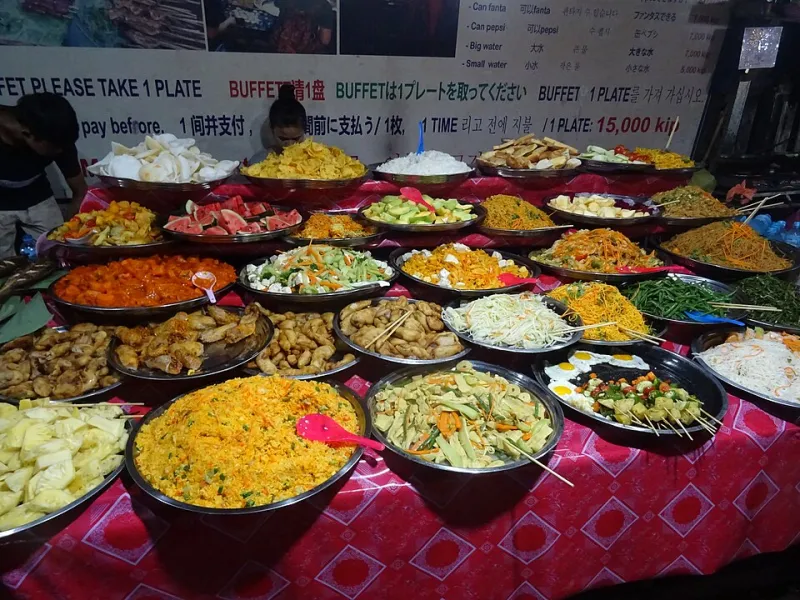
Photo: Christophe95, CC BY-SA 4.0, via Wikimedia Commons
It's 10:30 on a Friday night in a strip mall parking lot in Houston, and there's a line forty people deep for grilled skewers. Nobody's complaining. The string lights are on, a cover band is working through a bad-but-lovable rendition of a 2000s hit, and the smell of scallion pancakes and elote is hanging over everything like weather.
Ten years ago, this scene barely existed in America. Now it's one of the fastest-growing food traditions in the country.
A Very Old Idea, Imported
Night markets themselves are nothing new. In Taiwan, they're the beating heart of social life — the shilin experience of strolling, snacking, and running into half your neighborhood. Hong Kong's Temple Street, Bangkok's Chatuchak after dark, Mexico City's mercados that hum past midnight: across Asia and Latin America, eating outside at night isn't a novelty. It's how life is done.
What's new is that American cities — and importantly, American immigrant communities — are building their own versions from scratch. Not imported wholesale, but adapted: Taiwan-style night markets in Southern California, Southeast Asian night bazaars in Texas, pop-up lantern-lit food streets in Virginia.
The Vendors Building It One Skewer at a Time
Talk to the people behind the folding tables and a pattern emerges. Many of these vendors left careers — engineering, nursing, corporate whatever — to sell the food they grew up eating, because a night market booth is the lowest-barrier entry into business America offers.
A $50 tent permit. A borrowed generator. A family recipe for lumpia or jianbing or birria that's been in the group chat for generations. The night market is where a first-generation family can test whether their cooking has a future — and often, it does. Some of the most beloved brick-and-mortar restaurants in Richmond, Houston, and the San Gabriel Valley started as a table and a dream under temporary lights.
And the customers can tell. There's a difference between food made to be sold and food made to be shared, and you can taste it in the first bite.
Why This Moment, Why Now
A few forces converged. The pandemic left Americans hungry — literally and otherwise — for outdoor gathering that didn't feel sterile. Cities relaxed permitting rules to help small businesses survive. And a generation raised on food content developed an appetite for eating as an event, not a transaction.
But the deeper reason might be simpler: Americans are lonely, and the night market is a cure that doesn't require a membership, a reservation, or a single drink.
The Newest Third Place
Sociologists have a term for the spots that hold a community together outside of home and work: third places. Ray Oldenburg, who coined the phrase, meant barbershops, cafés, porches — the unstructured spaces where strangers become neighbors.
By that measure, the American night market might be the most successful third place built here in decades. Consider what it offers that other candidates don't:
- No cover charge. You can wander, browse, and people-watch without spending a dime.
- No age gate. Toddlers, teenagers, grandparents, first dates — everyone shares the same square footage.
- No alcohol requirement. Social life without a bar tab, which is rarer than it should be.
- Built-in conversation. When the food is unfamiliar, strangers ask strangers, 'What's that?' — and just like that, a connection.
Eat Like the World Is Awake
There's a particular magic to eating outside after dark that no restaurant has managed to replicate. The air is different. Time feels looser. In much of the world, the night market is where a city exhales.
America is learning that too, one parking lot at a time. So the next time string lights go up in a lot near you — Richmond, Houston, LA, or a town you'd never expect — go. Order the thing you can't pronounce. Ask the vendor about it. Stay past when you planned to leave.
That's not just dinner. That's a neighborhood being born.