What's on the Table Is Never Just Food: How Cultures Around the World Use Meals to Say 'I Love You'
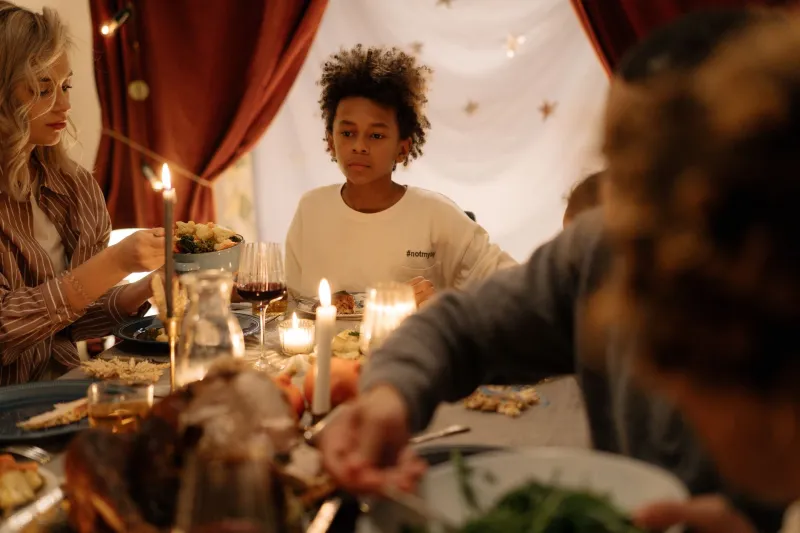
There's a moment that happens at dinner tables everywhere — a pause between bites, a refilled glass, a dish passed without being asked for. It lasts maybe two seconds. And yet somehow, it carries the weight of everything a person wants to say but can't quite put into words.
Food has always been a vehicle for something bigger than hunger. Across every culture on earth, sitting down to eat together is rarely just about eating. It's about showing up, staying present, and telling the people across from you — without saying a word — you matter to me. In a world that often feels fragmented and fast, that's a pretty radical act.
So let's take a seat at a few of those tables.
Italy: The Sunday Table as Sacred Ground
Ask any Italian American family in the U.S. about Sunday dinners and watch their whole demeanor shift. The eyes soften. There's usually a story involving a grandmother, a specific pasta shape, and a kitchen that smelled like garlic from 9 in the morning.
In Italy — and in deeply rooted Italian American households — the Sunday meal is practically a cultural institution. It's long, it's loud, and it is absolutely not optional. Multiple generations crowd around a table that somehow always has room for one more. Courses come out slowly, not because the cooking is behind, but because the point was never efficiency. The point was time. Time spent together, time that can't be rushed, time that signals: these people are worth lingering for.
Food in Italian culture is an act of devotion. When someone's nonna makes her ragù for six hours, she's not just making dinner. She's making a statement about love that no greeting card could compete with.
Japan: Precision, Presence, and the Art of Kaiseki
At the opposite end of the sensory spectrum — but arriving at the same emotional destination — is Japan's kaiseki tradition. Where an Italian Sunday dinner is exuberant and abundant, kaiseki is quiet, deliberate, and deeply intentional.
Originating as a tea ceremony accompaniment and evolving into a multi-course haute cuisine, kaiseki is built around the concept of ma — the meaningful space between things. Every dish is a small artwork: seasonal ingredients, balanced flavors, careful plating. Nothing is accidental. The meal is designed to make the guest feel seen, like someone thought deeply about what would nourish them in this exact moment, in this exact season.
For everyday Japanese families, this philosophy extends to the humble ichiju sansai — the traditional home meal of rice, soup, and three sides. It's modest by design, but the care embedded in its preparation carries the same message: I thought about what you needed today.
In both kaiseki and the family dinner table, the message is the same. Attention is love.
The Middle East: Mezze and the Generosity Principle
If you've ever sat down at a Lebanese, Turkish, or Persian table and been slightly overwhelmed by the sheer volume of small plates arriving before the main course even shows up — welcome to mezze culture, and also, you're in good hands.
Mezze isn't just an appetizer spread. It's a philosophy of hospitality that says: there will always be enough, and you are always welcome here. Hummus, baba ghanoush, stuffed grape leaves, warm flatbread, olives, cheeses — the table fills up not because anyone planned a specific menu, but because in Middle Eastern hospitality, abundance is a form of respect.
The act of sharing from communal dishes is also deeply intentional. You eat from the same bowls. You reach across each other. You tear bread and hand it to someone. Physical proximity and shared food blur the line between mine and ours, which is kind of the whole point.
For Arab Americans and diaspora communities across the U.S., recreating that mezze table — even in a Brooklyn apartment or a suburban Houston kitchen — is a way of preserving something irreplaceable. It's a way of saying we are still this.
West Africa: Food as Community Contract
In many West African cultures, the communal bowl is more than a serving vessel — it's a social contract. Families and communities eat together from a single large dish, and the ritual carries expectations of fairness, generosity, and presence.
In Senegal, the national dish thiéboudienne — a rich, fragrant rice and fish dish — is traditionally served in a communal bowl called a tefal. Everyone gathers around it. The eldest or the host serves others first. You eat what's in your section of the bowl. It sounds like a small logistical detail, but it teaches something profound: your needs exist alongside everyone else's. Community isn't just a concept; it's practiced, literally, three times a day.
This ethic of communal nourishment has traveled with African diaspora communities to the U.S., showing up in the soul food tradition, in the big pot that feeds everyone who shows up, in the unspoken understanding that a full table means a full community.
What This Means for Your Own Table
You don't need to master kaiseki or source the perfect mezze spread to bring some of this energy into your own home. The thread connecting all of these traditions isn't culinary expertise — it's intention.
It's putting the phone down. It's cooking something that takes a little longer than it needs to because the person you're cooking for is worth the extra hour. It's setting out more plates than you planned for, just in case. It's sitting with someone after the meal is done, because leaving too quickly signals that the food was the point — and the food was never really the point.
At Mahal Kita, we believe that loving the world means paying attention to how the world loves back — and so much of that love gets expressed in the oldest, simplest way humans have ever known. Someone cooked. Someone showed up. Someone stayed.
The table was set. And for a little while, everyone belonged somewhere.
Feeling inspired to explore a new food tradition? Try recreating a mezze spread for your next gathering, or experiment with the Japanese principle of intentional, seasonal cooking. Your dinner table might just become your favorite place to be.